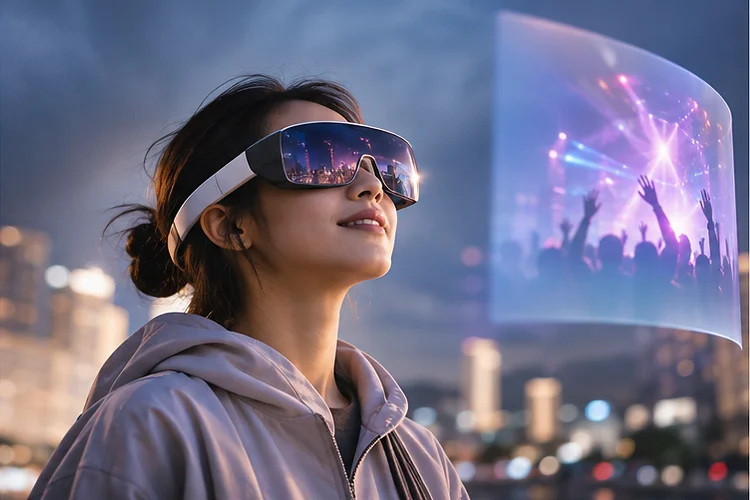
Watching movies, playing games, and exploring digital content have traditionally meant staring at a television, computer, or smartphone. But what happens when entertainment no longer needs to stay inside a fixed screen?
Wearable displays are opening possibilities for virtual theaters, interactive performances, and personalized media environments that move with the viewer.
Wearable Displays Could influence how entertainment platforms design content, deliver streaming experiences, and connect audiences. However, supporting these devices requires more than adapting existing video players.
Companies need to rethink content formats, interaction patterns, technical performance, and the overall relationship between digital entertainment and physical surroundings.
Moving Entertainment Beyond Traditional Screens
Traditional streaming platforms organize entertainment around familiar rectangular video players.
Wearable displays create opportunities to present content within flexible spatial environments instead.
Designing Virtual Viewing Spaces
Imagine watching a movie inside a virtual theater without traveling anywhere.
A compatible headset could display a large virtual screen while allowing users to adjust its position and apparent size.
Apple’s spatial and immersive media documentation describes video playback experiences designed for spatial environments.
These technologies can support different viewing arrangements, from conventional video windows to more immersive presentations.
However, larger virtual screens don’t automatically create better entertainment.
Developers still need to consider readable subtitles, comfortable viewing distances, and straightforward playback controls.
For example, a user watching a short news clip may prefer a simple floating video window instead of entering a complete virtual theater.
The most useful experience depends on the content and viewing context.
Creating New Opportunities for Immersive Storytelling
Traditional movies guide audience attention through camera framing and editing.
Immersive entertainment introduces additional creative possibilities by allowing viewers to explore environments and experience scenes with greater spatial depth.
Exploring Spatial Video and Immersive Media
Apple Immersive Video supports stereoscopic experiences with a wide field of view, accompanied by specialized production and delivery workflows.
This format creates opportunities for entertainment producers to experiment with different storytelling techniques.
For example, a concert documentary could place viewers close to a performance rather than presenting every moment through conventional camera angles.
A travel series might offer immersive views of famous destinations.
However, these formats require careful production planning.
Directors must consider where audiences naturally look and how important actions remain visible.
Too many simultaneous visual elements can make an experience confusing.
Strong immersive storytelling should use spatial depth to support the narrative rather than treating advanced technology as the main attraction.
Building Shared Entertainment Experiences
Watching entertainment with other people remains an important part of digital culture.
Friends often discuss movies, react to live performances, and participate in shared gaming sessions.
Wearable platforms could introduce new ways to enjoy these activities remotely.
Supporting Social Viewing and Virtual Presence
Apple’s SharePlay technology supports shared activities across compatible devices and applications.
On supported visionOS experiences, participants can interact through spatial representations while viewing shared content.
Imagine friends living in different countries watching the same movie within a coordinated digital environment.
They could discuss scenes while maintaining a sense of shared presence.
However, shared viewing requires dependable synchronization.
Playback controls, buffering differences, and temporary connection interruptions can create inconsistent experiences.
Platforms should allow participants to reconnect without losing their viewing progress.
Privacy controls are equally important because not everyone wants their reactions or activity to be visible throughout a session.
A successful shared environment feels social without making participation compulsory.
Using Spatial Audio to Improve Entertainment Experiences
Visual immersion attracts attention, but audio plays an equally important role in creating convincing digital environments.
Traditional entertainment systems already support surround sound and sophisticated audio formats.
Wearable devices can extend these capabilities through spatial audio processing.
Connecting Sound With Virtual Positions
Android XR documentation describes support for positional audio, spatialized stereo, surround sound, and ambisonic soundscapes.
These technologies can help create the impression that sound originates from particular locations.
Imagine watching a virtual concert where the lead singer appears ahead while instruments occupy different positions across the stage.
Compatible spatial audio processing can reinforce the relationship between visual objects and their apparent sound sources.
However, audio capabilities depend on the device and playback configuration.
Developers should verify supported formats before enabling specialized features.
Accessibility also matters.
Users may need mono audio, captions, or adjustable sound settings.
A realistic soundscape is only valuable when audiences can comfortably understand the content.
Designing Entertainment Platforms for Different Devices
Not everyone will adopt wearable entertainment devices at the same time.
Some people may prefer smart glasses for lightweight experiences, while others use immersive headsets for extended sessions.
Traditional smartphones and televisions will remain relevant alternatives.
Building Flexible Cross-Device Experiences
A practical entertainment platform should adapt its interface according to device capabilities.
For example, a music streaming service could provide a standard mobile interface alongside spatial album artwork and interactive visualizations on supported headsets.
The core account, playlist, and playback information can remain consistent.
However, developers need to consider platform compatiblity.
The WebXR Device API provides browser-based capabilities for supported virtual and augmented reality hardware, but MDN notes that availability remains limited across browsers.
This makes fallback experiences important.
Users should still be able to access essential content when immersive features aren’t supported.
Cross-device design should emphasize continuity instead of requiring completely different accounts or disconnected content libraries.
Improving Performance and Content Delivery
Wearable entertainment may involve conventional video, stereoscopic content, spatial audio, or interactive three-dimensional environments.
These formats can create different performance requirements.
A platform designed exclusively around standard mobile video may require additional optimization.
Balancing Media Quality and Device Limitations
For example, an immersive concert might combine high-quality video with animated visual effects and interactive information panels.
Each component consumes processing resources.
Android XR’s environment guidance recommends optimizing geometry, textures, and rendering complexity to maintain performance.
Developers can also reduce unnecessary visual details and avoid excessive interface animation.
Streaming applications should select playback formats compatible with their target hardware.
Network reliability remains important, particularly when users expect smooth playback during interactive experiences.
A technical workflow should measure startup delays, buffering, rendering stability, and session interruptions.
Regular device testing helps identify performance issues before they affect audiences.
Measuring New Digital Media Interaction Patterns
Traditional entertainment analytics focus on viewing duration, content completion, and return visits.
Wearable platforms may introduce additional interaction signals, including spatial interface selections and immersive feature usage.
However, these measurements need careful interpretation.
Connecting Engagement With Real Audience Value
Imagine a hypothetical streaming service introducing a new spatial viewing mode to 10,000 users.
If 4,000 try the feature and 2,500 complete an intended viewing session, the trial-to-completion rate is 62.5%.
That figure offers useful context, but it doesn’t automatically prove the experience is better.
Platforms should also examine user satisfaction, technical problems, and repeated voluntary usage.
Personlized recommendations could help viewers discover compatible immersive content, but users should remain in control of their preferences.
Privacy-conscious analtyics should avoid collecting unnecessary environmental or biometric information.
The objective is learning whether wearable features improve entertainment experiences rather than simply maximizing interaction counts.
Wearable Displays Could reshape digital entertainment by introducing immersive video, spatial audio, shared experiences, and more flexible content discovery.
However, sustainable adoption will depend on device compatibility, reliable performance, accessible interfaces, and meaningful audience benefits.
Entertainment companies should begin by testing practical spatial features alongside existing services. By focusing on viewer comfort and genuine engagement, platforms can explore new media experiences without abandoning what already works.