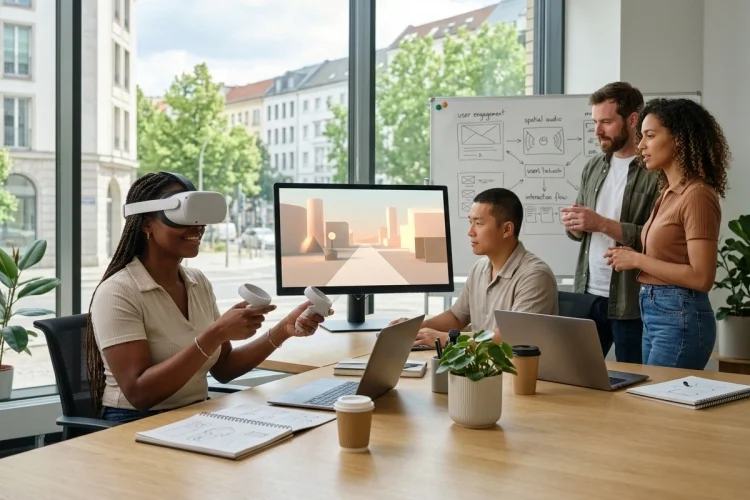
When people describe an immersive experience as “real,” they rarely mean every texture looked like a photograph.
More often, they mean they instinctively reached for something, reacted when someone entered their personal space, or briefly forgot they were wearing a headset.
That distinction matters when Designing Immersive Media. Presence is produced by relationships between perception, movement, interaction, sound, and attention.
Increasing graphical fidelity can help, but visual complexity also consumes performance budgets and creative resources. A smarter strategy is to build an experience that responds convincingly first and decorate it second.
Start With the User’s Body
Immersive media is unusual because the user’s body becomes part of the interface.
When people turn, reach, crouch, point, or walk, the digital world must respond in ways that match their expectations. This connection can create embodiment—the feeling that the user occupies and controls a body inside the virtual environment.
Research commonly breaks embodiment into three related components: body ownership, agency, and self-location.
Agency is especially important.
If users move their hands and virtual hands follow naturally, they begin to feel responsible for what happens. If tracking repeatedly breaks or movement behaves strangely, attention returns to the technology.
A relatively simple avatar with convincing motion can therefore feel more powerful than an ultrarealistic avatar that moves badly.
Synchronization Often Beats Graphical Fidelity
The brain continuously combines visual, spatial, proprioceptive, and other sensory signals.
Research on virtual embodiment shows that synchronization between real movements and virtual responses can influence body ownership and agency. Poorly calibrated movement, meanwhile, can disrupt embodiment.
Consider two virtual hands.
One has beautiful skin shaders but follows the player’s real hand slightly incorrectly. The other is a stylized glove that matches movement accurately.
The second may feel more natural because the relationship between intention and feedback is stronger.
This principle applies beyond VR hands. Objects, vehicles, tools, cameras, and characters all benefit from predictable action-response relationships.
Immersion depends heavily on responisve behavior.
Protect Performance as a Creative Feature
Visual complexity is not free.
More geometry, effects, dynamic lights, reflections, animations, and high-resolution assets increase computational demands. If that complexity creates unstable rendering or delayed interaction, visual improvements can work against immersion.
Recent research on human-centered VR systems highlights the importance of high frame rates, low input-to-output delay, and synchronized feedback for maintaining perceptual coherence.
This suggests a practical production rule: spend rendering resources where users actually notice them.
The main character’s face may deserve significant detail. A distant wall behind the user probably does not.
Performance optimization is not merely an engineering task performed after art production. It protects the illusion designers are trying to create.
Direct Attention Instead of Filling Every Space
Traditional visual design sometimes treats empty space as something to fill.
Immersive media works differently. Users can look around freely, which means excessive visual information can make an environment harder to understand.
A well-designed immersive scene directs attention using light, sound, motion, scale, contrast, and environmental composition.
Imagine entering a dark virtual station.
Instead of filling the space with dozens of animated screens, a designer could illuminate one platform while footsteps echo from a nearby tunnel. The user immediately understands where attention should go.
This is spatial storytelling.
Complexity should increase only when it adds information, emotion, atmosphere, or interaction value. Otherwise it becomes visual noise.
Make Objects Behave Believably
An immersive world teaches users its rules very quickly.
If one cup can be picked up, people may assume other cups can be picked up. If a drawer opens, similar drawers are likely to appear interactive too.
Breaking these assumptions creates friction.
Research on presence and plausibility emphasizes the importance of coherence and whether events match users’ expectations about what should happen.
Teams should therefore establish consistent interaction rules.
If most background objects are decorative, distinguish interactive objects naturally rather than forcing users to test everything. If physics matters, make object weight and collision behavior reasonably predictable.
A believable world does not need to simulate everything.
It needs rules people can understand.
Use Embodiment to Create Emotional Presence
Presence becomes especially interesting when digital events seem to happen to the user rather than somewhere on a screen.
Embodiment research has shown that virtual body ownership can intensify emotional responses to virtual stimuli.
This creates opportunities for entertainment, education, storytelling, and simulation.
Imagine a giant creature approaching.
A conventional screen shows the creature approaching a character. An embodied immersive experience can make the user perceive that creature entering their space.
The emotional difference comes partly from scale and graphics, but also from self-location.
That makes body placement, eye level, interpersonal distance, spatial audio, and character gaze powerful creative tools.
These elements can generate emotional immersion without enormous asset complexity.
Let Sound Extend the World Beyond Vision
Immersive scenes do not stop at the edge of the user’s current view.
Sound can suggest activity behind, beside, above, or below someone. It allows designers to expand perceived world size without rendering every event directly in front of the participant.
Apple’s spatial computing guidance encourages designers to use spatial audio both for environmental soundscapes and interaction confirmation.
A distant train, conversation behind a wall, or object falling outside the user’s field of view can make the world feel active.
Sound also helps users understand causality.
When a virtual switch produces an immediate sound from the correct position, the system confirms the action without requiring additional UI.
That small detail can significantly improve the overall experiance.
Increase Immersion Gradually
More immersion is not automatically better.
Apple’s visionOS guidance recommends thinking in terms of a spectrum of immersion and using only the amount necessary for the experience. Users can remain connected to their surroundings or move into more completely immersive spaces depending on the content.
This principle is useful beyond one platform.
A documentary might begin with familiar interface elements before expanding into a 360-degree environment. A game could introduce spatial interactions individually before combining them during intense sequences.
Gradual immersion gives people time to build confidence.
Once controls and spatial rules become familiar, users can devote more attention to narrative, exploration, or emotion instead of learning the interface.
Measure What Users Feel and Do
Rendering statistics cannot tell the entire story.
A technically complex environment may perform well yet fail to generate presence. Meanwhile, a smaller experience can succeed because its interactions feel natural.
Observe behavior during testing.
Do people instinctively lean closer to inspect objects? Do they react when virtual characters approach? Are their movements confident or hesitant? Do they repeatedly stop because they cannot understand an interaction?
Presence studies also use questionnaires and behavioral measures because the phenomenon includes perceptual and psychological components that are difficult to capture through rendering metrics alone.
The best test question may therefore be surprisingly simple: did users focus on the experience, or did they keep noticing the technology?
Designing Immersive Media does not require pushing maximum visual detail into every scene.
Strong presence grows from embodiment, responsive feedback, coherent rules, spatial audio, thoughtful attention design, and stable performance. Use graphical fidelity where it strengthens those foundations rather than competing with them.
Prototype the simplest version of your immersive world first, then add complexity only when testing shows that it makes the experience more convincing.