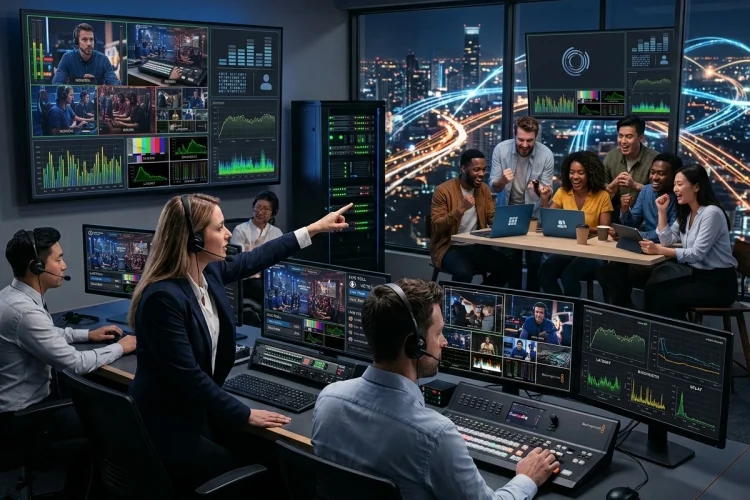
When viewers only watch, a few seconds of delay can be acceptable. When they speak to a host, bid in an auction, compete in trivia, control a remote experience, or appear inside the broadcast, those same seconds become painfully obvious.
This is where Advanced Low-Latency Architecture moves beyond traditional HTTP streaming and into real-time media technologies such as WebRTC.
Sub-second delivery changes the entire architecture: transport, NAT traversal, media routing, adaptive quality, monitoring, and scalability all become more demanding. The reward is an experience that feels like participation instead of delayed observation.
Know When You Actually Need WebRTC
Not every live stream should use a real-time transport.
WebRTC makes sense when interaction depends on extremely fast feedback.
Amazon IVS, for example, differentiates between low-latency streaming under five seconds and real-time stages that can deliver host-to-viewer latency below 300 milliseconds.
Cloudflare’s WebRTC streaming beta similarly targets sub-second playback for cases such as live sports, Q&A, auctions, and user-generated live broadcasts.
The tradeoff is complexity.
HTTP streaming works beautifully with ordinary CDN caching because millions of viewers can request the same media objects.
Real-time communication maintains more state and must react continuously to changing network conditions.
Use it when the interaction actually benefits from the difference.
Standardize Ingest With WHIP
Historically, WebRTC streaming providers often created custom signaling APIs.
That made interoperability harder.
WHIP, the WebRTC-HTTP Ingestion Protocol, addresses this problem by defining a simpler HTTP-based approach for ingesting WebRTC streams into media services and CDNs.
WHIP became IETF RFC 9725 in March 2025.
That makes it particularly important for modern broadcast workflows.
A production tool can publish WebRTC media using a standardized ingest model rather than requiring one proprietary integration per provider.
WHIP does not magically solve every streaming problem.
It standardizes an important boundary between the publisher and media infrastructure.
For architectures involving browsers, mobile creators, remote guests, or software encoders, reducing custom signaling can make the ingest layer easier to operate and replace.
Watch WHEP for Standardized Playback
The other side of the pipeline is playback.
WHEP-the WebRTC-HTTP Egress Protocol-is intended to provide HTTP-based signaling for viewers receiving WebRTC media from streaming services.
As of August 2026, WHEP is not yet a finalized RFC. The current IETF working-group draft is draft-ietf-wish-whep-04, published June 22, 2026 and in Working Group Last Call.
That distinction matters.
Teams should not describe WHEP as a completed internet standard yet.
Still, real implementations already exist. Cloudflare’s WebRTC streaming beta supports WHIP ingest and WHEP playback with sub-second latency.
This suggests a direction toward more interoperable real-time streaming pipelines rather than every vendor maintaining completely unique playback signaling.
Use SFUs Instead of Sending Everyone Everywhere
Pure peer-to-peer architecture breaks down quickly when many participants need media.
If every person sends a separate high-quality stream directly to every other participant, upstream bandwidth and encoding requirements grow rapidly.
A Selective Forwarding Unit, or SFU, provides a more scalable middle layer.
MDN describes SFUs as intermediary servers that receive media from senders and selectively forward suitable streams to recipients.
Simulcast and scalable video coding can provide several quality options so the SFU chooses what fits each viewer’s network and device.
This is especially valuable in interactive broadcasts with hosts, guests, and audience participants.
The broadcaster can send several layers.
A viewer with excellent bandwidth receives a high-quality layer, while someone on a weak mobile connection receives a lighter one.
The SFU avoids transcoding every possible combination when forwarding can do the job.
Plan for STUN, TURN, and Difficult Networks
WebRTC cannot assume that every user can establish the ideal network path.
Firewalls, NAT devices, enterprise networks, and carrier infrastructure can interfere with direct connectivity.
ICE coordinates connection discovery using candidates provided through technologies such as STUN and TURN. When direct networking is impossible, TURN can relay traffic through an intermediary server.
That fallback is essential for reliablity.
It is also expensive.
TURN-relayed media consumes server bandwidth, so infrastructure capacity needs to be sized for real usage rather than an assumption that nearly every connection will be direct.
Amazon IVS’s real-time networking documentation also shows why UDP accessibility matters. Its real-time service uses UDP by default for low-latency media, with TCP fallback available in some receiving scenarios.
Test restrictive corporate Wi-Fi, mobile carriers, VPNs, and unusual NAT conditions-not only developer networks.
Adapt Video Without Building a Large Buffer
Traditional streaming can hide bandwidth fluctuations by buffering more media ahead.
A real-time experience has much less room for that strategy.
If the application adds five seconds of safety buffer, it is no longer very real-time.
Instead, WebRTC systems adapt bitrate, resolution, and frame rate as network conditions change.
Simulcast helps by publishing multiple versions of the same source. SVC can encode layers inside a scalable stream. The SFU can then forward an appropriate representation rather than forcing every recipient to receive the same quality.
This changes the optimization target.
Maintaining conversation timing is often more valuable than preserving maximum image quality.
A temporary drop from 1080p to 540p may be acceptable.
A five-second freeze during a live auction is not.
Real-time architecture should degrade visually before it stops being responisve.
Treat Data Interaction and Video as One Product
Interactive streaming frequently includes more than video.
Chat, reactions, polls, game state, remote controls, scores, bidding, and moderation events may all operate beside the media session.
These systems must share a coherent time model.
If a trivia answer arrives before a slower participant sees the question, the experience becomes unfair. If audience reactions appear too late, conversation feels awkward.
Measure the round trip for interactive data separately from video delivery.
Sometimes data should travel as quickly as possible.
Sometimes it needs synchronization with a specific media timestamp.
The correct choice depends on the interaction.
Architecture should therefore be designed around the entire live experience rather than treating video and application events as unrelated systems.
Monitor Network Quality With WebRTC Stats
Server metrics alone cannot describe a real-time session.
Browsers expose detailed connection information through WebRTC statistics APIs. RTCPeerConnection.getStats() can return reports about the overall connection or individual media tracks.
Related RTP statistics can include measurements such as packet loss, jitter, and round-trip time.
Collect these signals with care.
Look for deteriorating RTT, rising loss, unstable bitrate, reconnects, TURN usage, join failures, and quality-layer changes.
Segment them by geography, ISP, device, browser, and network type.
Average latency can look excellent while a small but important audience segment experiences severe packet loss.
Real-time systems are sensitive to tail performance.
The slowest or least stable sessions often explain complaints better than the global average.
Consider a Hybrid Streaming Architecture
One technology does not need to serve every audience.
A host and twelve participants might communicate through WebRTC at sub-second latency while hundreds of thousands of passive viewers receive the resulting program through LL-HLS.
Amazon IVS explicitly supports the concept of real-time stages that can be broadcast onward to low-latency channels. Stage participants experience real-time latency while channel viewers receive scalable low-latency distribution.
This hybrid pattern is powerful.
Use real-time infrastructure where two-way interaction matters.
Use CDN-friendly HTTP delivery where massive one-way scale matters more.
The audience can even move between layers.
A viewer invited onto the virtual stage may transition into a WebRTC session, participate, then return to HTTP playback afterward.
Architecture becomes more efficient when latency tiers match user roles instead of forcing everybody through the most expensive path.
Advanced Low-Latency Architecture for interactive streaming requires choosing the right latency tier for each audience role.
WebRTC, WHIP, SFUs, TURN, adaptive media layers, and detailed network telemetry can deliver true real-time interaction, while LL-HLS can handle larger passive audiences efficiently.
Map which users actually need sub-second communication first, then build the architecture around those interaction boundaries.