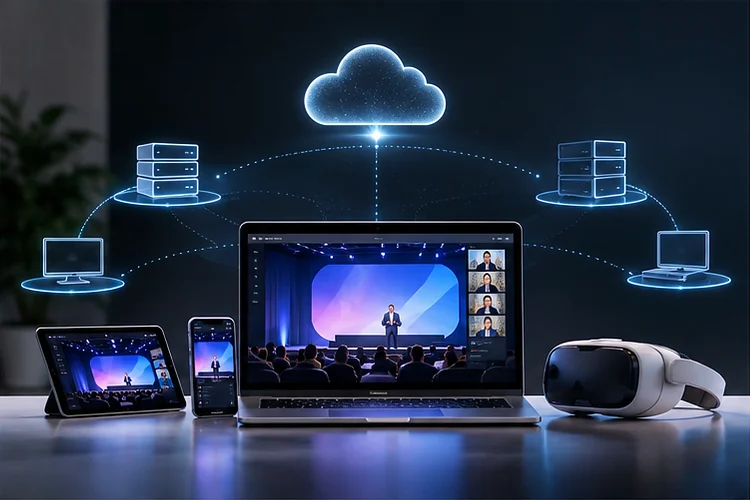
Getting thousands of people to attend an online event is impressive. Keeping them interested, connected, and actively involved is a completely different challenge.
Global audiences expect more than a video player and a chat window. They want responsive interactions, easy navigation, accessible content, and the freedom to participate from almost any device.
Advanced Virtual Event Architecture makes these experiences possible by connecting intelligent application design with dependable real-time technology.
Rather than focusing exclusively on streaming capacity, modern event platforms must also consider audience behavior, communication tools, accessibility, and security throughout the entire event journey.
Designing Virtual Events Around Audience Experience
A successful virtual event begins long before someone clicks the play button.
Registration, login, session discovery, and navigation all influence how attendees perceive the platform.
Complicated interfaces create frustration, especially when participants are joining from different countries and using different devices.
Modern event platform design focuses on removing unnecessary steps.
For example, attendees should be able to enter a scheduled session directly from their personalized agenda without searching through multiple pages.
The interface should also display essential information clearly, including session times, speaker details, and participation options.
Behind the scenes, modular application services help support these features without overwhelming the main platform.
Separating registration, scheduling, and content services allows each component to scale according to its specific workload.
Building Interactive Experiences With Low Latency
Interaction transforms a virtual conference from passive content consumption into an engaging digital experience.
Live polls, questions, reactions, and networking sessions encourage participants to become part of the conversation.
However, these features depend on efficient communication between attendees and application servers.
Choosing the Right Real-Time Technology
WebSockets can support continuous communication for features such as chat, live reactions, and status updates.
WebRTC is particularly useful when participants need real-time audio and video communication.
For example, a networking session involving several speakers may benefit from WebRTC-based media routing.
Meanwhile, a keynote presentation reaching tens of thousands of viewers can use a broadcast streaming architecture.
Amazon IVS also supports timed metadata that synchronizes interactive elements with video playback.
This matters when attendees receive the stream at slightly different times.
A quiz question should appear when the relevant presentation segment plays, not simply when the organizer presses a button.
Thoughtful synchronization makes interactive features feel more natural and keeps participants focused.
Making Global Events Accessible to Everyone
International audiences bring different languages, network conditions, accessibility needs, and device preferences.
A platform that works beautifully on a desktop computer might feel completely different on a budget smartphone.
That’s why responsive layouts and accesible interfaces should be treated as essential architectural requirements.
Supporting Captions and Flexible Playback
Live captions help attendees follow presentations when listening to audio is difficult or impossible.
The Web Content Accessibility Guidelines, or WCAG 2.2, include live caption requirements at Level AA for applicable synchronized media.
Multilingual captioning and translated subtitles can also improve participation for international audiences.
However, translation quality should be reviewed, especially when speakers use technical terminology.
Event interfaces should support keyboard navigation, readable contrast, and clear focus indicators.
Platforms should also provide adaptive playback options for viewers with unstable internet connections.
The goal is straightforward: make important content available without forcing everyone to use the same device, language, or connection speed.
Protecting Event Access and Participant Information
Large virtual events often involve personal information, private presentations, and potentially sensitive business discussions.
That makes security an important part of event architecture rather than an optional feature.
Authentication systems should verify attendee permissions before granting access to restricted sessions.
Role-based access control can assign different permissions to organizers, speakers, moderators, sponsors, and viewers.
Securing Video and Application Services
Signed playback URLs help protect private video content by requiring valid authorization tokens.
For example, a paid conference might generate temporary streaming credentials for registered attendees.
Those credentials can expire automatically after a specified period.
API rate limiting, secure session management, and appropriate bot protection can reduce abuse against registration or login services.
Organizers should also avoid displaying personal information in public chat messages or unnecessary notifcations.
For international events, privacy requirements may differ by jurisdiction, making data storage location and retention policies important planning decisions.
Security controls should protect participants without making legitimate access unnecessarily complicated.
Monitoring Event Performance in Real Time
Even a feature-rich platform can disappoint users when technical problems go unnoticed.
Real-time observability gives engineering teams insight into what attendees are actually experiencing.
Instead of only monitoring CPU usage, organizers should track video startup failures, buffering, connection drops, and unsuccessful login attempts.
Connecting Metrics With User Experience
OpenTelemetry provides tools for collecting metrics, traces, and logs across distributed application services.
These signals can help teams identify which component is responsible for a particular problem.
Imagine attendees reporting that a breakout session takes too long to open.
A monitoring dashbord might reveal that the delay comes from an overloaded authentication service rather than the video infrastructure.
Engineers can then investigate the specific bottleneck instead of restarting unrelated systems.
Monitoring should also distinguish between geographic regions and device categories.
A problem affecting mobile viewers in one country may remain invisible when performance data is averaged across the entire audience.
Using Event Data to Improve Future Experiences
The technical value of a virtual event continues after the live broadcast ends.
Audience analytics can help organizers understand participation patterns, identify popular sessions, and evaluate engagement features.
For example, a conference might attract 20,000 registrations but only 12,000 actual viewers.
Rather than treating that difference as a failure, organizers can investigate registration timing, reminder effectiveness, and event scheduling.
Session completion rates and interaction patterns can reveal which presentations maintained attention.
However, engagement metrics should be interpreted carefully. A participant who watches quietly may still gain considerable value.
Collect only the information needed for meaningful analysis, and apply appropriate privacy safeguards.
Recorded sessions, searchable transcripts, and relevent follow-up resources can further extend the event’s usefulness.
This turns one live experience into an ongoing source of learning and community interaction.
Advanced Virtual Event Architecture isn’t only about supporting bigger audiences. It’s about creating digital environments where participants can communicate, learn, and interact without unnecessary technical barriers.
By combining accessible interfaces, low-latency features, strong security, and meaningful analytics, organizers can deliver more valuable online experiences.
Start by reviewing your attendee journey, identifying performance gaps, and building an event platform that genuinely supports global participation.